St. Clair County IL
A.R.E.S. & R.A.C.E.S. OPERATION GUIDE
 |
Prepared by American Radio Relay League
Emergency Coordinator -Eugene Kramer-WA9TZL
in cooperation with St. Clair County RACES
Coordinator Ed Matysik - ARS- W9RQR.
|
|
 |
Looking for St. Clair County AL - Click
Here!
Click HERE
for the Beaufort Wind Scale (for general use by ARES/RACES / Skywarn members).
Click HERE
for a current list of ARES/RACES Members. (Updated
06/2008)
Click HERE
for Amateur Radio Operators manual for St. Clair County. (Updated 7/11/07)
Ed Matysik - W9RQR
Voice of WC9AAE RACES Station
Gene Kramer - WA9TZL
St. Clair County ARES Coordinator
The close working relationship between the St. Clair County Emergency
Management Agency and the St. Clair County Amateur Radio Emergency Service
has made it possible to discuss any Emergency that occurs within the boundaries
of St. Clair County, requiring support amateur radio communications, to
involve the RACES NET CONTROL Station. The license assignment for the RACES
officer in St. Clair County is to Mr. Ed Matysik (personal ARS call sign
of W9RQR). The St. Clair County RACES amateur radio call sign is WC9AAE
and as issued by the Federal Communications Commission is used at all times
that "Life and/or property is threaten within the jurisdiction for which
the RACES station was established...". This is one of the reasons that
Amateur Radio Emergency Services of the ARRL encourages working relationships
with County and local ESDA/EMA operations.
The contact point, request point, for Amateur Radio support communications
to the RACES officer and the ARES EC is made via the St. Clair County Emergency
Services & Disaster Agency (ESDA) or Emergency Management Agency of
the Region (EMA Region 8). The "support communications" agreements with
the Hospitals within St. Clair County specify requests for Amateur Radio
Emergency Communications through the St. Clair County ESDA center, referred
to as "CENT-COM".
RACES Qualifications: Mr. Ed Matysik, W9RQR was formerly the ST. Clair
County Civil Defense Communications Officer for the St. Clair County Civil
Defense as well as the Temporary Coordinator of the St. Clair County Emergency
Services & Disaster Agency (names changed in 1975). Mr. Matysik was
also the Coordinator of the city of Belleville in the ESDA. Mr. Matysik
holds a General Class Amateur Radio License.
ARES Qualifications: Gene Kramer, WA9TZL has an Associate In Applied
Science Degree in the area of Electronic Technology , has been the Coordinator
of the ESDA for the City of Freeburg since 1973. Gene is a full time employee
of the Illinois State Police in District #11, the Headquarters located
in Collinsville, Illinois. Mr. Kramer's role with ISP is the Communications
Technician-In-Charge (T.I.C.), and holds a General Class Amateur Radio
license and FCC General Radiotelephone License.
REGISTRATION WITH ST. CLAIR COUNT RACES & ARES
The training for an Amateur Radio Emergency Services member and a Radio
Amateur Civil Emergency Service (ARES/RACES) member is essentially the
same. The application for membership into both operations begins with the
ARRL ARES registration form. This form contains the vital information required
by the ARES EC and the RACES Coordinator as it asks the applicant for information
concerning radio equipment owned and emergency power capabilities. The
other important information on this form concerns your telephone contact
numbers as well as your address. This registration form MUST be completed
and ON File with the ARES EC and RACES Coordinator in order to receive
the ARES membership card. The ARES membership card AND your FCC Amateur
Radio License will identify you in times of an emergency to enter areas
restricted to only this type of Support Communicators operator.
The American Radio Relay League has
a Memorandum of Agreement (MOA) form which identifies support communications
cooperation and identifies with the ARES card for immediate identification
in times of emergency response by amateur radio operators. The St. Clair
County ARES has an ARRL MOA on file to assist the Illinois State Police
- District #11 - Collinsville during area wide emergencies, such as an
Earthquake, with support communications.
COMMUNICATIONS NET:
The recognized Communications Net for ARES/RACES operations within
ST. Clair County Illinois is the RACES NET that operates EVERY TUESDAY
EVENING AT 1900 HOURS LOCAL TIME on the St. Clair
County Amateur Radio Club VHF repeater frequency of 147.720/147.120
Mhz. This is a "roll call style" net to provide information and coordination
to amateur radio ARES/RACES members. The Net Control Station -RACES callsign
is --WC9AAE--. All operators will be under the direction of the net control
station. If the net control station suddenly disappears from the system,
a designee shall assume net control until the main control station returns.
The Net Control Station Coordinates ALL radio traffic into and out of the
affected area of the emergency and may make allocations for "alternate"
operators to move to simplex frequencies for "staging operations". If the
St.
Clair Amateur Radio Club repeater is struck by lightning or has other
difficulties preventing it's use, the Net Control Station will move to
SIMPLEX first to announce an alternate stay on the 147.120 mhz frequency
to monitor for calls and Net Control will move to the other VHF Amateur
Repeater system in St. Clair County on 145.110 Mhz.
Net Control for the St. Clair County ARES/RACES will have direct contact
with the St. Clair County Emergency Management Agency via itself or designated
alternate amateur radio operators. The alternate ARES frequency within ST.
Clair County is the 444.625 Mhz Repeater (St. Clair Amateur Radio UHF Repeater). The main Repeater (K9GXU)
site is six miles SE of Belleville off of Rt. 15./13.
OPERATING PROCEDURES:
In an emergency communications situation, it is VERY important to do
the following:
-
Listen first: do not immediately "jump" into the NET unless you have emergency
traffic.
-
When called be sure to state your call sign with Phonetics, i.e., "W"-william
, "A"-alpha, "9", "T"-tango , "Z"- zulu, "L"-lima. This aids in immediate
identification and reduces air repeat time.
-
NEVER leave your home or work unless NET Control has an urgent need to
request you to do so, do not do anything "ON YOUR OWN"! This is especially
true if ESDA has not requested support communications to the area. RACES
means that the County ESDA will be involved in potential Workman compensation
coverage IF you are providing the "Support Communications" in the field
for ESDA. If the request is for amateurs from St. Clair County ARES to
assist, for example, the Illinois State Police, you still operate under
a Net Control, but you WILL NOT BE COVERED under any insurance but the
insurance you carry on yourself. Again, DO NOT ENDANGER YOURSELF OR OTHERS
BY RESPONDING TO AN EMERGENCY ON YOUR OWN !
-
BE prepared - have a fresh battery pack ready at all times for your portable
transceiver. If at all possible try to carry an "Alkaline case" or "dry
pack" as the battery cases are called that use standard alkaline batteries.
You may be in an area that you can not readily obtain AC power to recharge
a depleting NICAD battery pack.. Carry an extra antenna adapter, especially
the SO239 to BNC adapters. These are relatively inexpensive BUT come in
handy when you are asked to connect to an external antenna that may exist
at a Hospital, ESDA office, etc. When a fixed base or mobile transceiver
fails, the extra DB of power for both receive and transmit from your portable
could be a life saver on an external antenna - be prepared to CONNECT!
-
Paper /Pad/Pencil-Pen/Map: even with the advent of electronic planners,
there is no substitute for the paper and pad mode of operation. Instructions
from NET CONTROL and/or requests for relay from other stations or the Served
Agency (Police, Fire, ESDA, Red Cross, Salvation Army, etc.) can become
pure trauma if you're trying to "remember" what was needed/requested. Amateur
Radio has been a very professional means of getting the message through
for years and this is true because of ACCURACY of information. The need
to carry a map, especially of St. Clair County, should be a real consideration
if you are not familar with the area AND if an ARES / RACES from a surrounding
County makes a request for assistance.
-
Support Supplies: in the event you may be "stationed" at a shelter, roadblock,
hospital, etc., for an extended period of time, you may consider carrying
a "support" back pack or other type of portable carrier that will allow
you to carry bottle water, non-perishable foodstuffs (snacks), flashlight
& extra batteries as well as a portable AM/FM radio (small) to add
to the Emergency Broadcast/Emergency Alert System Information from radio
station KMOX on 1120 kHz AM in this area.
-
CONDUCT: remember YOU are representing several areas. First, you are representing
the Amateur Radio community. Secondly, you are representing the ARES/RACES
organization. Thirdly, you are representing YOURSELF AS AN INDIVIDUAL.
Professionalism both ON the air and in person reflects on ALL THREE AREAS.
Remember the News Media is everywhere in an Emergency scenario, don't make
comments or act in a manner that would adversely affect us all. NEVER ASSUME!
Also ask NET CONTROL when in doubt. A large SCANNER audience is out there,
especially during times of an emergency - THINK BEFORE YOU SPEAK- think
how it will sound to others. This is NOT the time for idle chit-chat jargon,
or "funnies" on the air. Remember who you represent-at least three areas!
HOW ARE YOU NOTIFIED:
The method of contacting members of the Amateur Radio Emergency Service/Radio
Amateur Civil Emergency Service depends on the type of emergency situation
and the urgency for support communications. In an AREA Wide emergency,
the request for RACES/ARES will be made by the St. Clair County Emergency
Services and Disaster Agency and/or Emergency Management Agency Region
8 via telephone to the RACES Coordinator. If telephone lines are severed
or not available the request will be made from St. Clair County ESDA/EMA
's Radio Dispatch Center (CENT-COM) via radio pager notification to the
ARES EC for St. Clair Co. If the request for Emergency Support ARES/RACES
communications is immediate, a telephone tree call out from the ARES/RACES
members registration will begin. Again, if telephone communications is
down, the NET Control STATION -WC9AAE will activate and make repeated announcements
on the St. Clair County Amateur Radio Club Repeater
of 147.120 Mhz or the 145.110 Mhz repeater for amateur operators.
GUIDELINES FOR RESPONSE:
Earthquake - if you feel the earth move to the point where doors and
windows rattle, items fall from shelves, ext., immediately turn your VHF
rig ON to the NET frequency.
-
If the sky has turn extremely dark (this is not a SKYWARN lesson) and winds
are pushing you and or other objects about and/or hail is falling -immediately
turn your VHF rig ON to the NET frequency.
-
If you hear directly and/or hear from NEWS media broadcast about explosions
and/or large scale - area wide fires, turn your VHF rig ON to the NET frequency.
-
When making an inquiry on the NET frequency, use PLAIN TEXT English, do
not use CW phrases such as QRV, QTH, QRU, as some operators not associated
with CW will become confused and cause unnecessary air time delays by repeats.
These terms should be used if using HF (explained later in this manual)
for both SSB and/or CW operations.
NET CONTROL WILL ISSUE "TACTICAL" ID'S:
The NET CONTROL operator will issue the "tactical call sign" when operators
are asked to report to areas other than their fixed home locations. An
operator sent to Memorial Hospital for support communications would still
identify with their FCC assigned call every 10 minutes, BUT NET CONTROL
would call that operator (site) by its "Tactical Identification (ID),i.e.,
Memorial Hospital. This saves time and reduces confusion, especially if
an operator reliefs another operator at the same site.
HF RADIO OPERATIONS:
The American Radio Relay League recognizes the importance of World
Wide Communications capabilities during emergency situations. All ARRL
appointed Emergency Coordinators with the Amateur Radio Emergency Service
are responsible for reporting into the Illinois ARES NET on the 1st and
3rd Sundays of each month at 1630 hours local time on 3.950 Mhz Lower Sideband
during the fall and winter seasons and optional 7.230 Mhz during the Spring
and Summer months. The ARRL Section Emergency Coordinator conducts this
roll call net with all 102 Illinois Counties with ARRL EC's and their designees.
ARES / RACES members licensed to work HF frequencies may be asked to
report to one of the following frequencies for "Outside Assistance" requests
and/or relay of data to the ARRL Section Emergency Coordinator:
|
|
|
CALL
|
| Illlinois ARES Net |
3.905Mhz/7.230 Mhz |
W9QBH |
| Illinois Phone Net |
3.855 Mhz |
KA9CYJ |
| Illinois Section Net |
3.665 Mhz |
K9QEW |
| llinois Sideband Net * |
3.905 Mhz |
WB9TVD |
*Operates as part of the National Traffic System
PACKET COMMUNICATIONS:
NET CONTROL may ask for Digital Communications between sites, especially
if Red Cross or Salvation Army "sheltering" operations are extensive. The
important area here is for "Portable Packet" stations if at all possible.
With the exception of some Government offices and emergency facilities,
emergency power may be limited and a full-blown PC may not be practical.
If you have PACKET capabilities OR other digital modes from Home with no problems with AC power,
you may be asked by NET Control to establish a simplex link and provide
information to NET Control if you can not relocate to NET Control's position
with your station. The PACKET frequencies most likely to be used include:
145.090 Mhz, 144.930 Mhz, 145.070 Mhz, and 145.010 Mhz as well as 145.030
Mhz.
ALERTING DEVICES:
There are several radio receivers available on the market that will
enhance the "ALERTING/WARNING" capabilities to alert you to immediately
reach for your VHF Amateur transceiver and tune to the Net Control Frequency
(147.120 Mhz). The One Single Receiver that the Federal Emergency Management
Agency and the Federal Communications Commission is embracing is that of
the NOAA Weather Alert Receivers. The NOAA , National Oceanic & Atmospheric
Administration has established a system throughout the United States to
alert populous of life threatening severe thunderstorms, tornadoes, flash
floods, and Winter storm related threats to life and property. The network
of NOAA operations and the low cost of the receivers has rapidly moved
the old Emergency Broadcast System of alerting people of area wide emergencies
into the National Alert System which involves the NOAA Weather Radio Network
already in place.
The NOAA weather radio receivers are soon to become the MAIN FOCUS FOR
ALL HAZARDS ALERTING including forewarning of the following conditions:
-
Severe Thunderstorm Watches and Warnings for the area
-
Tornado Watches and Warnings for the area.
-
Winter Storm Watches and Warnings, including Heavy Snow, Ice storms, etc.
-
Earthquake magnitude data follwing an earth movement (or event as it is
known).
-
Any threats from outside the United States (Nuclear/Meteor impacts/ etc.)
The receivers used to receive this information is presently known as the
NOAA Weather-radio and there are several makes and models of this unit
and they are not expensive. Tandy Corporation makes several models (Radio
Shack) but it is EXTREMELY IMPORTANT THAT YOU OBTAIN THE RECEIVER THAT
HAS THE ALERT FEATURE, NOT ONE THAT MERELY RECEIVES THE NOAA BROADCASTS.
There is even a NEW NOAA receiver that has just been introduced to the
consumer market and sold by Radio Shack called S A M E NOAA WEATHER RADIO
RECEIVER. This unit is more expensive (around $80.00 compared to around
$25-$40.00 for the standard Weather Alert Receiver) But the S A M E receiver
will active its ALERT TONE ONLY FOR THE AREA YOU PREPROGRAM,I.E., St. Clair
County. S A M E stands for Specific Area Message Encoding.. Our area of
NOAA Tone Alerting coverage is on the frequency of 162.550 Mhz. This receiver
is highly recommended to all ARES/RACES members as a "paging" -"pre-alerting"
device!
FREQUENCY MONITORING -EMERGENCIES:
Once you have been alerted to the hazardous situation/emergency whether
by experiencing it or by the use of the NOAA Weather Radio System, switching
to the St. Clair County ARES/RACES frequency of 147.120 Mhz and/or 444.625
Mhz for further information from NET CONTROL is vital. There are other
frequencies that are designated to the rebroadcast or initial broadcasts
of emergency information during Hazardous /life/property threat conditions
and they include the following:
|
FREQUENCY
|
DEPARTMENT /EMERGENCY RESPONSE AGENCY
|
| 155.475 Mhz |
Illinois State Police Emergency Radio Network |
| 155.370 Mhz |
ALL Police Departments "Point to Point" Base Stations |
| 42.500 Mhz |
All Illinois State Police District Base Stations |
| 155.055 Mhz |
Illinois Radio Emergency Assistance Channel-Fire, Police, ESDA, etc. |
| 158.835 Mhz |
St. Clair County ESDA "Cent-Com" -all ESDA units, Schools. |
This information for monitoring purposes ONLY and can provide you with
possible "first" indication of an emergency situation that you might be
requested to provide support communications. Remember to attempt radio
contact with the RACES/ARES NET CONTROL station for clarification of any
traffic you copy from the listed frequencies.
Do not act on the information you monitor on these frequencies, always
check with NET CONTROL.
147.120 Mhz-Primary 145.110 Mhz-secondary
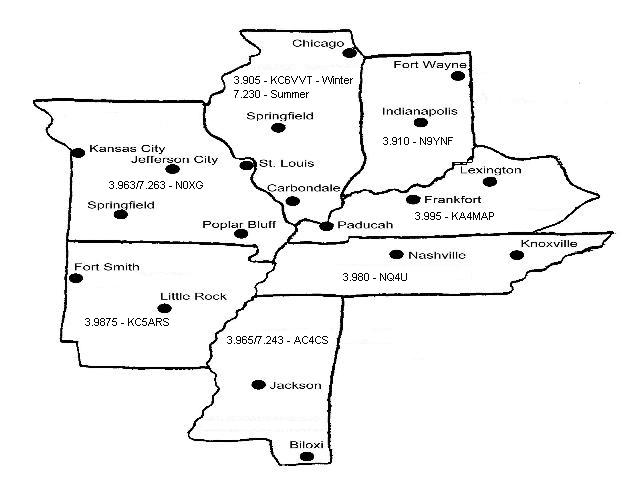
Seven State Earthquake Affected Area
Midwest: New Madrid Fault Threat
Amateur Radio Communications Links Via ARES
American Radio Relay League 1990 Net Listings
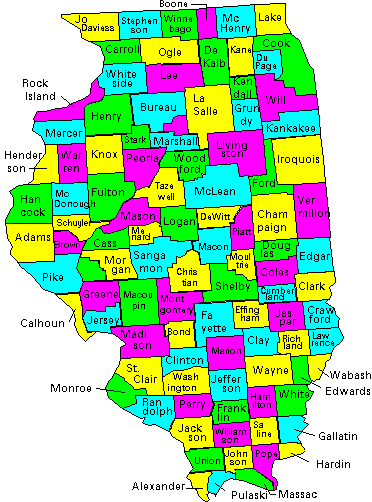
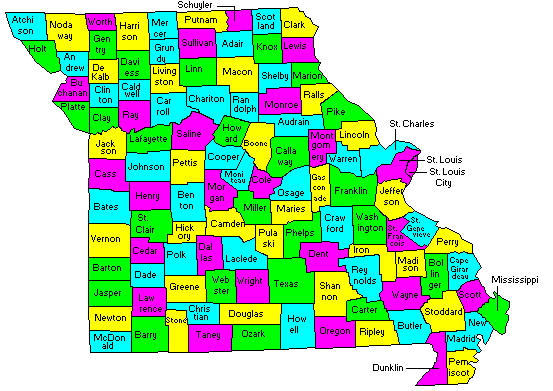
COUNTY MAPS
Click On Image For Larger View
RELATED INFORMATION
Public Service Communications Manual From the ARRL
ARRL Numbered Radiograms
- PDF Format - Microsoft
Word Format
ARRL Amateur Message
Form - PDF Format
- Microsoft Word Format
ARRL Operating
Aid - (Communications Procedures, Phonetic Alphabet, RST System, Time
Conversion Chart)
Other Places On the Net To Find Related information
Emergency
Managers Weather Information Network
Missouri-Illinois Regional
SKYWARN Association
National Skywarn Homepage
National Weather Service
St. Louis
Storm Spotter's
Guide
Vortex St. Louis
St. Clair County Amateur Radio Club Home Page